Call: +44 (0) 1173 353635 Email: info@green-flare.com


The Science Behind Heat Pumps
Heat pumps don’t generate heat in the way a boiler burns gas or oil. Instead, they move heat from one place to another – usually from the air or ground outside your home, into your central heating system.
This is made possible by a clever cycle of heating and cooling, where a special fluid called a refrigerant absorbs heat from the environment, this is then transferred through a heat exchanger to your hot water cylinder. Which then provides the heating and hot water for your property.
Because they move existing heat rather than create it, heat pumps can be incredibly efficient – often delivering three to five times more heat than the electricity they use. That means lower running costs and fewer carbon emissions.


Air Source vs Ground Source Heat Pumps
At Green Flare, we install both Air Source and Ground Source heat pumps. Both work on the same principle, but they collect heat in different ways.
Air source heat pumps take warmth from the air outside, even when outdoor temperatures are well below 0 degrees. They’re the most common type of heat pump in UK homes and are usually quicker and easier to install.
Ground source heat pumps collect heat from underground, using pipes buried in your garden or drilled deep into the ground.
Because the ground stays at a fairly steady temperature all year, these systems are often even more efficient – but they do require more space or specialist drilling equipment.
Our team will help you decide which system best suits your property and goals, based on your space, insulation and budget.
The Components of a Heat Pump
Although heat pumps rely on sophisticated engineering, the system is made up of a few main parts that work together to move heat into your home.
-
The evaporator takes heat from the air or ground and uses it to turn a refrigerant into gas. The boiling point of the refrigerant is so low (usually less than -50 degrees C) that it evaporates into a gas even when the outside temperature is below freezing.
-
The compressor squeezes the gas into a smaller volume which increases the temperature of the gas.
-
The condenser transfers the heat from the refrigerant to your hot water cylinder, radiators or underfloor heating. As the refrigerant cools, it becomes a liquid.
-
The expansion valve controls the flow of high-pressure liquid into the evaporator and resets the system so it can start again.
These parts form a continuous cycle, powered by electricity. The system also includes smart controls and thermostats, allowing you to manage your heating more efficiently.
At Green Flare, we design every heat pump system to match your property’s layout and your comfort preferences – so the whole system works reliably, quietly, and effectively from day one.
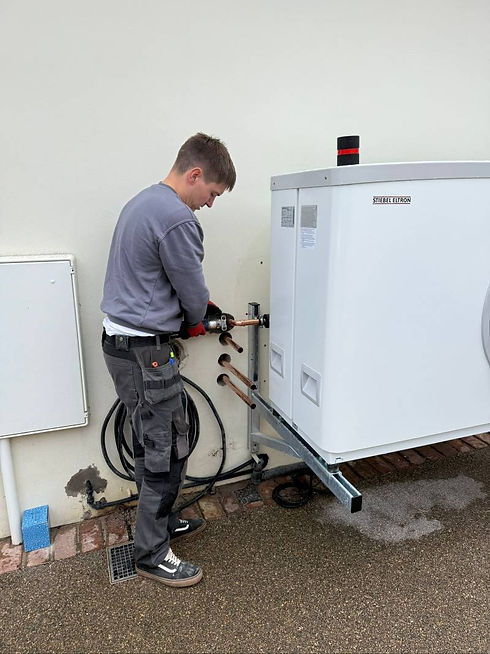

Heat Pumps vs Conventional Heating
Most homes in the UK still rely on gas or oil boilers, which work by burning fuel to create heat. However, this approach is less efficient and contributes directly to carbon emissions.
Heat pumps offer a cleaner, more sustainable alternative. Instead of burning anything, they collect free heat from the environment which is used to heat your home. The electricity grid is getting greener all the time, using a heat pump that runs on electricity is one of the best ways to cut your home’s carbon footprint.
A typical gas boiler runs at about 90% efficiency. A heat pump can reach 300–500% efficiency, meaning it can give back three to five times more heat than the energy it uses. No fuel deliveries, no combustion, and no flue gases – just a more modern, future-proof way to heat your home.
Approved Installations


